Why Warner Bros. Discovery shareholders might opt for Paramount's offer — and why they might not
Key Points
- Paramount executives are reportedly reaching out to Warner Bros. Discovery (WBD) shareholders to see if they are willing to sell their shares, even though WBD’s board has advised against it and is instead backing a deal to sell its studio and streaming businesses to Netflix.
- On Monday, Paramount revised its proposal by adding a personal financial guarantee from Oracle co-founder Larry Ellison, which would support about $40.4 billion in equity funding for the transaction.
- Shareholders who choose to tender their shares at $30 per share may believe Paramount’s all-cash offer is more attractive or more likely to receive regulatory approval.
- Those who decide not to tender could be signaling concerns about Paramount’s financing structure or confidence that Discovery Global’s long-term value could be higher.
Here’s a fully original, copyright-free rewrite of your text for a blog post, keeping it neutral, clear, and readable:
Why Warner Bros. Discovery Shareholders Face a Tough Choice Between Paramount and Netflix
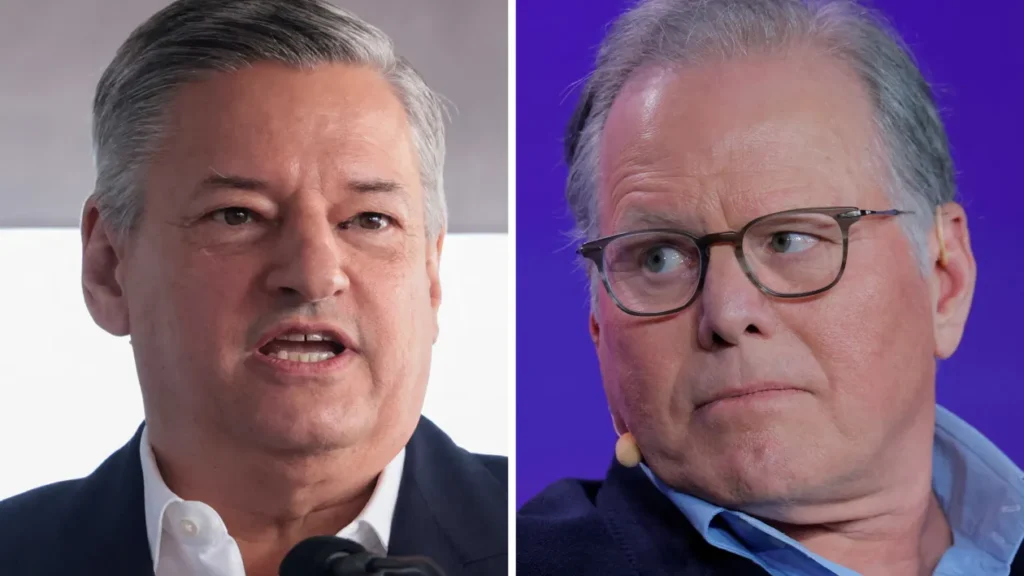
Hours before Warner Bros. Discovery (WBD) agreed to sell its studio and streaming assets to Netflix, Netflix co-CEO Ted Sarandos called WBD CEO David Zaslav to confirm that Netflix would not increase its offer.
Now, WBD shareholders have a chance to respond to Paramount’s competing bid. Shareholders have until January 21 to tender their shares to Paramount for $30 in cash, though Paramount could extend the deadline up to WBD’s annual meeting, which has not yet been scheduled.
If Paramount acquires 51% of WBD shares, it would control the company—even though WBD’s board has already agreed to sell the studio and streaming assets to Netflix. Both companies can now speak with shareholders to see whether they prefer Paramount’s offer or will follow the board’s recommendation to sell to Netflix.
Reasons to Tender
Some shareholders may choose to accept Paramount’s offer for two main reasons:
- Higher immediate value: Paramount’s $30-per-share all-cash offer covers the entire company, compared with Netflix’s $27.75-per-share bid for just the studio and HBO Max. Paramount argues that the full deal plus a valuation for Discovery Global (the remaining linear cable networks like CNN, TNT, HGTV, and TBS) is more favorable.
- Trigger a bidding war: Tendering to Paramount could prompt Netflix to increase its offer or encourage Paramount to raise its bid. Paramount CEO David Ellison has stated that the $30-per-share offer is not final, leaving room for negotiation.
Shareholders may also view Paramount’s cash offer as more likely to gain regulatory approval. Paramount+ has about 80 million subscribers, presenting fewer antitrust concerns than Netflix, which has over 300 million global subscribers.
Reasons Not to Tender
Other shareholders may hold off for strategic reasons:
- They could benefit more from Netflix’s offer if Discovery Global is spun out as a separate publicly traded company. Analysts suggest the value of Discovery Global could exceed the $1 per share currently assumed in Paramount’s bid.
- Regulatory and political challenges could delay or block the Paramount deal, which includes funding from Middle Eastern sovereign wealth funds. Shareholders may prefer to wait for a safer outcome that protects the value of Discovery Global.
Funding Concerns
Paramount recently revised its offer to address shareholder worries. Oracle co-founder Larry Ellison has guaranteed $40.4 billion in equity funding for the deal, though the Ellison family’s personal investment remains at $12 billion. Paramount also clarified the assets held by the family trust and its liabilities.
Despite these assurances, some WBD executives have questioned whether the financing is strong enough, jokingly referencing the 1970 film Where’s Poppa? to express uncertainty. Still, for many shareholders, the source of funds is less important than its availability.
The deal is supported by three major sovereign wealth funds: the Saudi Public Investment Fund, Abu Dhabi’s L’imad Holding Co., and the Qatar Investment Authority, all of which have extensive experience investing in U.S.-based deals.
The Shareholder Dilemma
WBD shareholders now face a classic choice: accept Paramount’s immediate cash offer, with the potential for a bidding war, or hold out for Netflix and Discovery Global, which may offer higher long-term value but comes with greater uncertainty.
Ultimately, the decision will balance short-term gains, regulatory risk, and long-term strategic value, making it one of the most closely watched corporate battles in recent years.